
Sports Betting Opportunity Cost: Compound Interest vs. Wagering
Understanding the Hidden Cost of Every Bet
Most sports bettors evaluate success through short-term outcomes: today's picks, this week's profit and loss, winning percentages, or whether they beat the closing line.
While these metrics matter, they overlook a far larger financial reality: opportunity cost.
Every pound, dollar, or euro committed to sports betting is capital that cannot simultaneously participate in long-term wealth creation. Whether a wager wins or loses, money allocated to a sportsbook is money that is not compounding elsewhere.
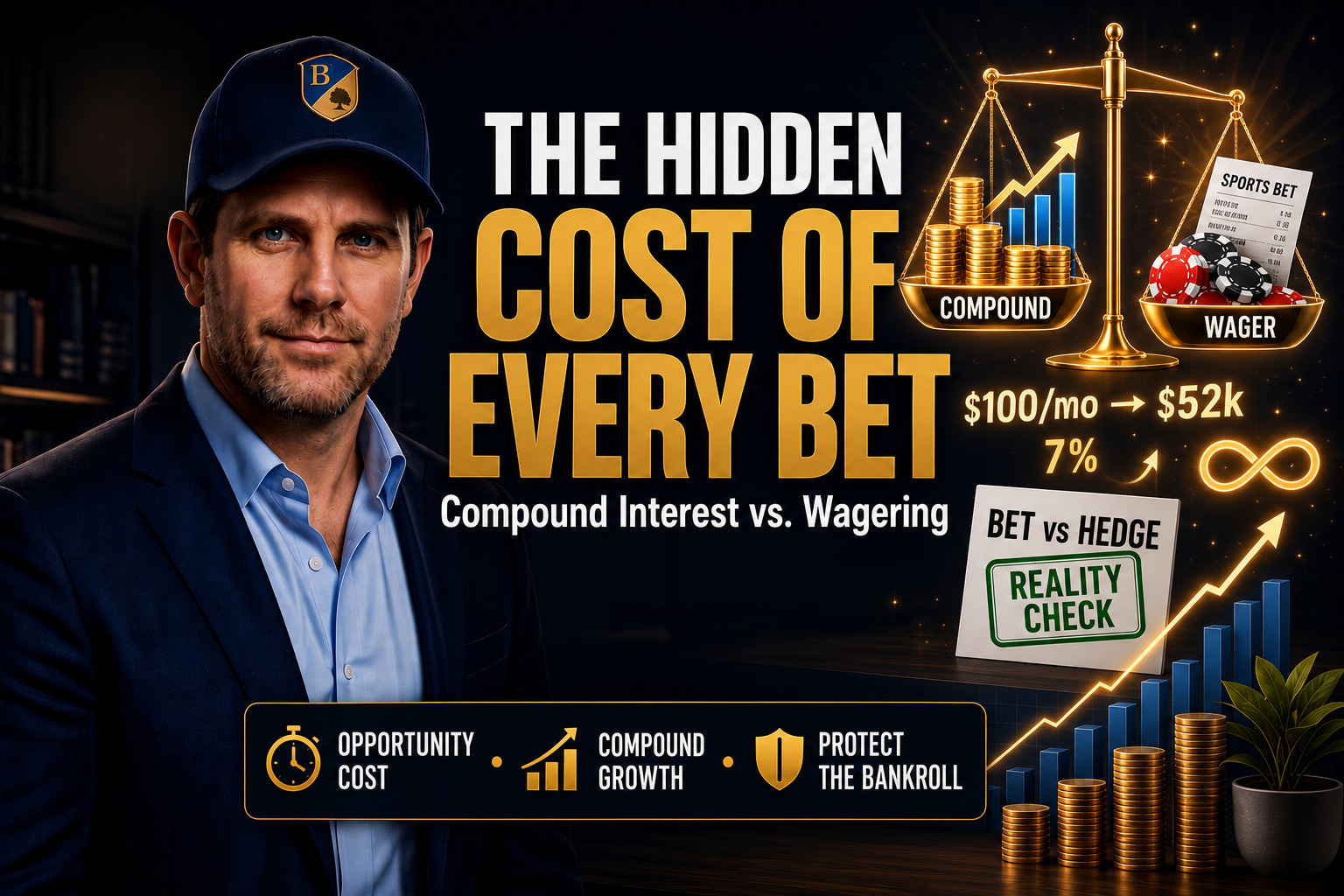
This is the principle behind the Bet vs. Hedge Reality Check. The tool is not designed to tell users whether they should bet or invest. Instead, it visualises the long-term trade-off between spending capital on recreational wagering and allocating that same capital to productive assets capable of compound growth.
To understand why this trade-off becomes so powerful over time, we need to examine three concepts:
- Compound interest
- Sports betting expected value (EV)
- Opportunity cost
1. Compound Growth: The Engine Behind Long-Term Wealth
The most powerful force in investing is not stock selection, market timing, or forecasting.
It is compounding.
Compounding occurs when investment gains are reinvested, allowing returns to generate additional returns. As the investment horizon increases, growth begins to accelerate because gains are being earned on previous gains.
The standard future-value formula for recurring investments is:
Where:
- FV = Future value
- P = Initial investment
- PMT = Recurring contribution
- r = Periodic return
- n = Number of periods
The key insight is that compound growth is not linear.
An investor may see modest progress during the first decade, meaningful growth during the second decade, and substantial acceleration during the third and fourth decades.
Historically, broad equity markets such as the S&P 500 have generated positive long-term returns over extended periods, although future returns are never guaranteed and markets experience significant periods of volatility and decline.
The important point is not the exact return.
2. Sports Betting and Expected Value
Unlike investing, sports wagering does not automatically benefit from a positive growth engine.
Every wager begins with a question:
Bookmakers build a profit margin into market prices through what bettors call the vig, juice, or overround.
Consider a typical point-spread market:
Team B 1.91 / −110
The implied probability for each side is:
Adding the probabilities gives:
The amount above 100% represents the bookmaker's overround.
This means the market is constructed so that participants collectively pay a pricing premium for access to the wager.
Whether a specific bettor wins or loses depends on skill, discipline, timing and variance.
However, the critical mathematical concept is expected value:
A positive-EV bettor has a statistical advantage.
A negative-EV bettor does not.
While a small minority of bettors may develop genuine edges through specialised modelling, market inefficiencies, arbitrage opportunities or superior information, most recreational bettors face the challenge of overcoming both market efficiency and bookmaker margins.
As a result, many betting activities function primarily as entertainment expenditure rather than long-term wealth-building activities.
3. Opportunity Cost: The Cost Nobody Sees
For most recreational bettors, the true financial cost of wagering is not simply the amount lost.
It is the value that money could have generated elsewhere.
Economists refer to this as opportunity cost.
Suppose a bettor spends:
- $100 per month
- $1,200 per year
- $24,000 over twenty years
Most people immediately focus on the $24,000.
The more important question is:
4. Worked Example: Betting vs Investing
Assume a recreational bettor allocates $100 per month to sports wagering for 20 years.
Now assume the same $100 per month is instead invested into a diversified low-cost index fund producing a hypothetical 7% annualised return.
Investment Scenario
| Period | Contributions | Portfolio Value (7%) | Growth Generated |
|---|---|---|---|
| 10 Years | $12,000 | $17,308 | $5,308 |
| 20 Years | $24,000 | $52,093 | $28,093 |
| 30 Years | $36,000 | $121,997 | $85,997 |
Illustration only. Assumes $100 is invested at the end of each month and a 7% annual return compounded monthly, before fees, taxes and inflation. Figures rounded to the nearest dollar.
Notice what happens.
During the first decade, growth appears modest.
By year twenty, investment gains exceed the original contributions.
By year thirty, the portfolio has generated more than twice the amount contributed.
The investor did not contribute $121,997.
They contributed only $36,000.
The remainder came from compound growth.
This is why opportunity cost increases over time. The foregone growth often becomes larger than the original spending itself.
Importantly, these figures are illustrations rather than predictions. Actual investment returns vary and future market performance is uncertain.
5. Why Betting Often Feels More Attractive Than Investing
If the mathematics of compounding are so powerful, why do many people still prefer wagering?
The answer is rooted in behavioural finance.
Immediate Rewards Beat Delayed Rewards
A winning bet can provide excitement within hours.
Compound growth often requires years before meaningful results become visible.
Humans naturally place greater value on immediate rewards than distant outcomes, a phenomenon known as present bias.
The Lottery Effect
Large parlays and longshot wagers offer small probabilities of substantial payouts.
The possibility of a transformative win often receives disproportionate attention compared with the far more likely outcome.
The Illusion of Control
Sports betting involves research, statistics, injury reports and analysis.
Because knowledge is involved, bettors may overestimate their ability to outperform highly efficient markets.
This phenomenon is known in behavioural economics as the illusion of control.
The existence of skill does not guarantee the existence of an edge.
6. A Practical Middle Ground
Recognising opportunity cost does not mean eliminating wagering entirely.
For many people, sports betting is a leisure activity similar to travel, dining out or other entertainment expenses.
A more sustainable framework is to separate entertainment spending from wealth-building capital.
The Partitioned Bankroll Approach
Prioritise:
- Emergency savings
- Retirement contributions
- Long-term investments
- Discretionary entertainment spending
Only then allocate capital to betting.
The Split Strategy
Suppose your recreation budget is $200 per month.
Instead of wagering the entire amount:
- Invest $100
- Wager $100
This preserves the entertainment value of betting while allowing part of the budget to compound over time.
Hedging Future Wealth
The most effective hedge against uncertain future outcomes is often not another wager.
It is ownership of productive assets that can appreciate, generate income, and compound over long periods.
The Bet vs. Hedge Reality Check projects what a monthly betting budget could become if some or all of it were invested instead. To mirror the example above, enter 100 as the monthly betting budget, 0 as the monthly investment, a 7% investment return, and ages 30 to 50 — the 100% scenario shows the 20-year figure.
Open the Reality Check →Key Takeaway
Sports betting and investing solve fundamentally different problems.
Betting provides entertainment, engagement and the possibility of short-term gains.
Investing provides exposure to long-term compound growth.
The hidden cost of a wager is not necessarily the stake itself.
For many recreational bettors, understanding that trade-off is more valuable than analysing any individual game, market, or betting system.
BetAndHedge provides analytical, educational and informational content only. Nothing contained on this website constitutes financial, investment, legal, tax or gambling advice. Users remain solely responsible for their own decisions and should conduct independent research before making any financial or wagering commitments.